
Gas rarefaction — where the continuum assumption of classical Navier-Stokes-Fourier (NSF) equations breaks down — plays a critical role in many technological applications such as micro-electro-mechanical systems (MEMS), vacuum systems, atmosphere reentry and hypersonic flight [1,2]. Reentry flows are especially interesting, as they combine low gas density with high speed flow.
At high altitudes, around 100 to 150 km, the molecular mean free path — i.e. the distance a gas molecule travels between collisions — is comparable to the characteristic length scale, namely the size of the reentry capsule. Under these conditions, the assumption that the gas behaves as a smooth, continuous fluid breaks down. However, even at lower altitudes, roughly 50 to 100 km, where the molecular mean free path is smaller than the characteristic length scale, the continuum assumption can still fail locally [3]. Due to the high reentry speed, gas molecules in front of the vehicle are abruptly compressed, forming a bow shock. This bow shock is an extremely thin region in which the gas experiences a sudden increase in temperature, pressure, and density. Because the shock layer is so thin, its thickness can become comparable to the distance a gas molecule travels between collisions, leading to local continuum breakdown. In addition, along the surface of the vehicle, a boundary layer forms where the gas slows down due to friction with the wall. This boundary layer is a strongly non-equilibrium region in which gas properties such as velocity and temperature vary very rapidly, making it difficult for classical fluid models to accurately capture the physics. Finally, behind the capsule, the wake region contains highly expanded, low-pressure gas where molecules interact more frequently with the capsule than with each other, again violating the continuum assumption. To accurately capture these non-equilibrium phenomena, simulation methods that go beyond classical CFD and directly model gas behavior at the molecular level are required.
At FLOW Matters Consultancy, we apply high-fidelity Direct Simulation Monte Carlo (DSMC) [4] simulations to investigate rarefied gas flows. DSMC is a stochastic particle-based method that reproduces the physics of the Boltzmann equation by tracking the motions and collisions of a large number of computational particles representing the real gas molecules. The DSMC method is valid in the whole range of gas rarefaction from the continuum regime, where intermolecular collisions dominate the flow behavior, down to the free-molecular regime, where intermolecular collisions are scarce.
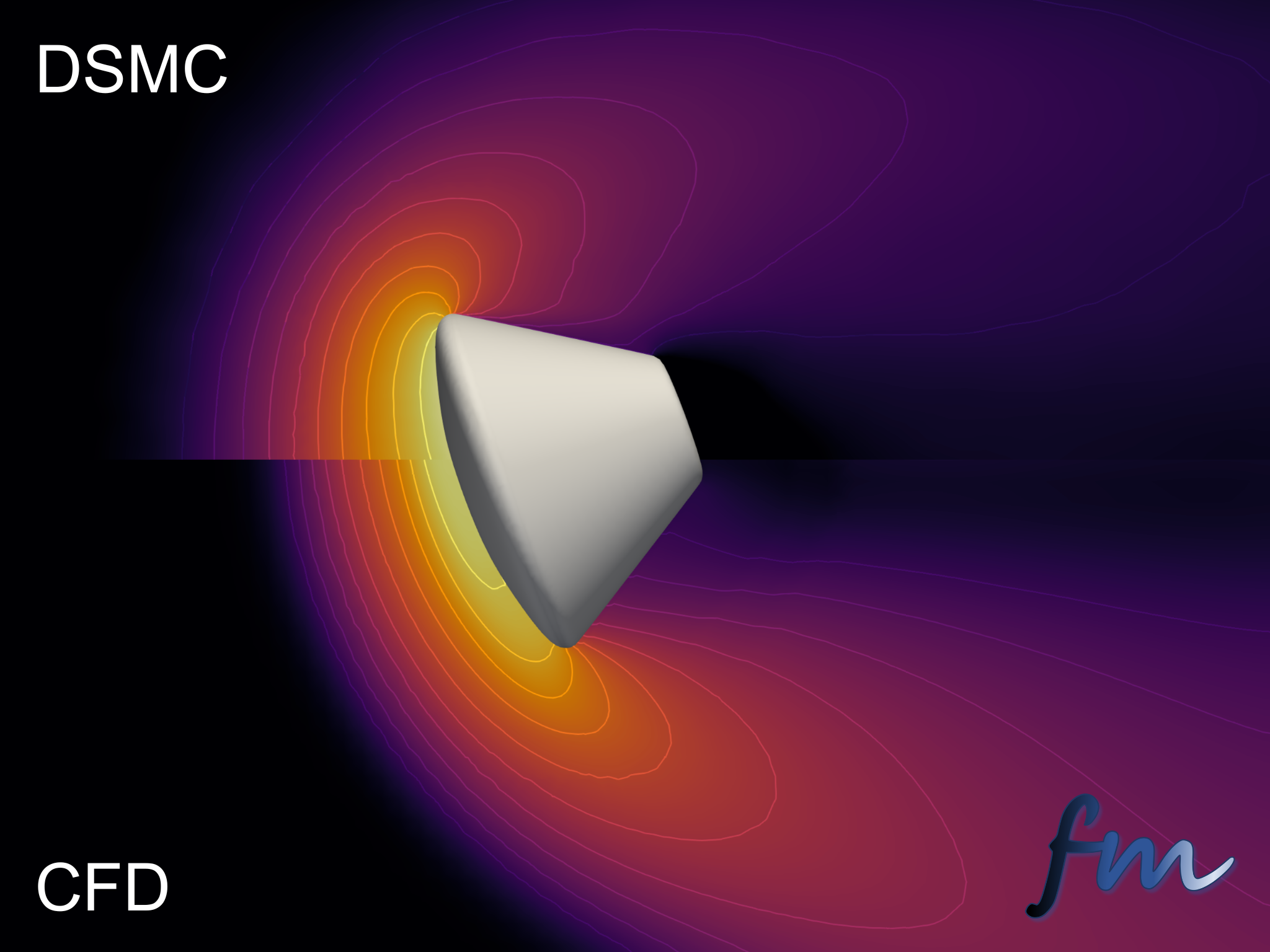
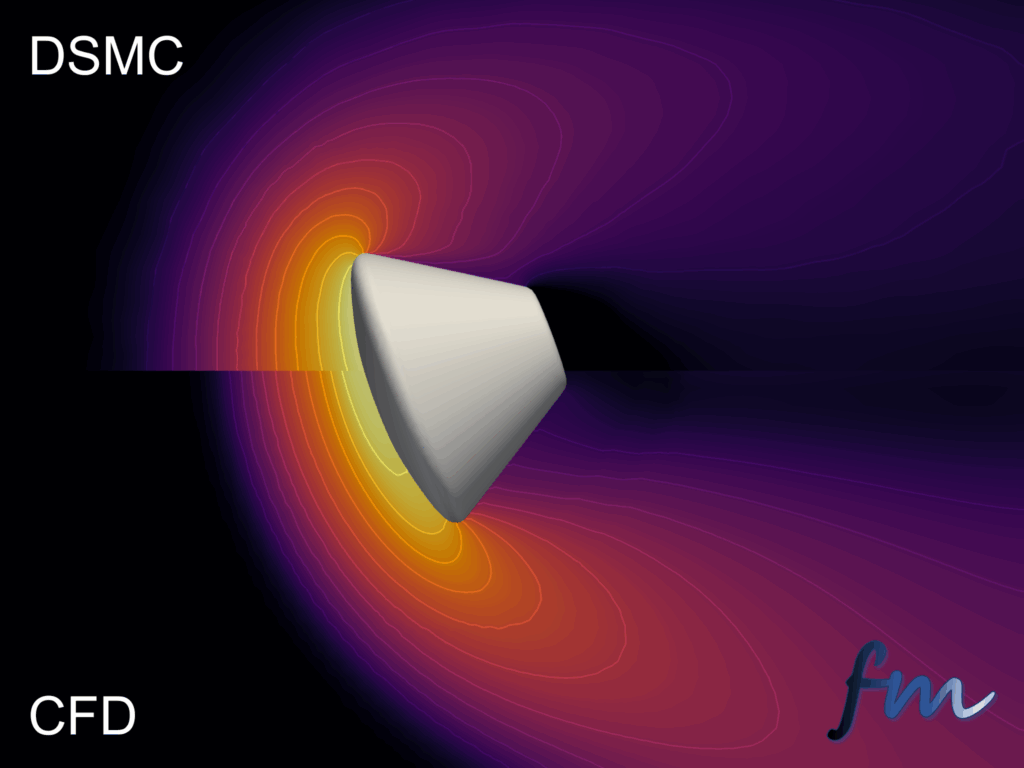
To compare the performances of classical CFD (NSF) and DSMC, we simulate NASA’s Orion space capsule re-entering the Earth atmosphere at an altitude of 110 km and a reentry speed of 3800 m/s (Mach 15). The comparison of the pressure field obtained with the two methods is reported in the figure above. It is clear that gas rarefaction plays an important role in accurately simulating reentry flows: NSF tends to underpredict the bow shock standoff distance and thickness due to overprediction of intermolecular interactions. The bow shock structure is crucial in correctly predicting the vehicle heat load, which is typically underpredicted by NSF, and designing the Thermal Protection Systems of the vehicle. These insights matters not just for Orion, but for any high-speed vehicle transitioning through the upper atmosphere.
This project highlights our commitment to delivering cutting-edge simulation tools that bridge the gap between fundamental research and real-world applications. At FLOW Matters, we harness high-fidelity modeling techniques — like DSMC — to provide accurate, physics-based insights where traditional methods fall short. From MEMS and vacuum systems to spacecraft reentry, we help our clients design with confidence in even the most extreme flow environments.
[1] N. Vasileiadis, C. White, “hybridDCFoam: A coupled DSMC/Navier–Stokes–Fourier solver for steady-state multiscale rarefied gas flows”, Adv. Eng. Softw., vol. 193, 2024.
[2] N. Vasileiadis, G. Tatsios, C. White, D. A. Lockerby, M. K. Borg, L. Gibelli, “uniGasFoam: A particle-based OpenFOAM solver for multiscale rarefied gas flows”, Comput. Phys. Commun., vol. 310, 2025.
[3] W. Wang, I. Boyd, “Predicting continuum breakdown in hypersonic viscous flows”, Phys. Fluids, vol. 15, 2003.
[4] G. A. Bird, “Molecular Gas Dynamics and the Direct Simulation of Gas Flows”, Clarendon, 1994.
Leave a Reply